


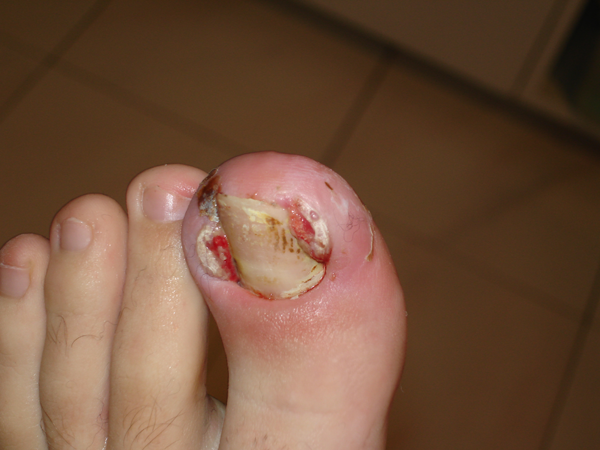
Incarnate nails
An ingrown toenail occurs when the edge of the nail that grows inside the nail fold enters the soft tissues of the fingers. It is very likely that there will be pain and inflammation as a result of a local infection due to the accumulation of pathogens. In diabetics or people with poor circulation, this small problem can lead to an infection with serious consequences.

Causes
The appearance of the ingrown toenail can be the result of several causes, but it is mainly attributed to a combination of two situations: an improper cutting technique, and wearing the wrong footwear.
- When nails are cut too short with rounded edges
- Wearing shoes that are too tight compress the skin of the toe with the outer edge of the nail. It is very rare the appearance of this illness in people who do not wear shoes
- Some deformities of the fingers and trauma can cause the germinal matrix to have an abnormal growth of the nail that favors the appearance of the ingrown nail.
- In children, ingrown toenails often develop as a result of cutting the nails with the hand by tearing them.
- An inherited tendency to form ingrown toenails.
- It most often occurs on the big or big toe.
Symptoms
- The nail penetrates inside the skin of the outer edge of the finger, producing local pain and hypersensitivity in the area.
- Lateral pain on palpation or when walking.
- The edge of the nail becomes red, swollen, and it is not uncommon for it to drain pus.
- It usually occurs on the big toes.
Prevention
Preventive treatment is the best weapon against this type of pathology:
- Make sure to wear appropriate shoes and socks
- When grooming finger nails:
- Use a clean, sharp nail clipper.
- Trim your toenails straight across the tip, don't round the corners or trim them too short.
- Don't pick or tear your nails
- Do not try to trim the ingrown part of the nail yourself, as this will only make the problem worse.
Treatment
Our Podomedical Center we definitively solve the problem through minimal surgery when the problem is recurrent. It consists of removing the spicule, which is the part of the nail embedded in the flesh, and ablation of the nail matrix.

In the following image, an ingrown toenail is shown after surgery.

In our practice we use, if the patient requires it, conscious sedation administered by an anesthesiologist in order to minimize surgical stress. This system is ideal for very nervous children and adults.
Once the patient is deeply sedated, the big toe is anesthetized with a local anesthetic.

Immediately afterwards, the nail is detached from the meat in its lateral portion and the portion of the nail is cut along with the corresponding nail matrix in order to avoid the recurrence of the problem and save the toenail.


I suffered from that infection when I seemed to have to see a doctor lla because I've had a nail like this for a year and it doesn't heal me it came from this one of your answers
it is always best to go to the podiatrist, in my case this is chronic and I go every 3 or 4 months to remove the Ingrown toenail
Excuse me, I am looking for a place where they can help my daughter with this problem because the IMSS doctors do not give me a solution and they only have it based on injections, ointments and surgeries that have not helped at all.